
March brings together two conversations that, while different in origin, are deeply connected: women’s health and the visibility of endometriosis.
On one hand, this month invites us to reflect on progress, gaps, and ongoing realities surrounding women’s health. On the other hand, Endometriosis Awareness Month highlights a condition that affects millions of women and is still often diagnosed too late.
In Mexico, this overlap is significant. It creates an opportunity to speak clearly about what we know and what still needs attention.
Women’s health in Mexico: a shifting perspective
In Mexico, more than 40% of women do not seek medical care regularly. This speaks to the importance of building a culture of prevention, something that, for a long time, wasn’t actively encouraged. For many women, normalizing pain, pushing through discomfort, and continuing with daily life became the default.
The encouraging news is that this is beginning to change. Conversations around fertility, hormonal health, and overall well-being are becoming more common, and that represents real progress.
However, there is still a noticeable gap between awareness and access to care. Many women continue to face:
- Late diagnoses
- Symptoms that are minimized or dismissed
- Limited access to specialists
- Confusing or inconsistent information about reproductive health
Endometriosis is one of the clearest examples of this gap. This condition affects millions of women and, on average, takes years to diagnose, partly because pain is often assumed to be normal.

Endometriosis in Mexico: more common than it seems
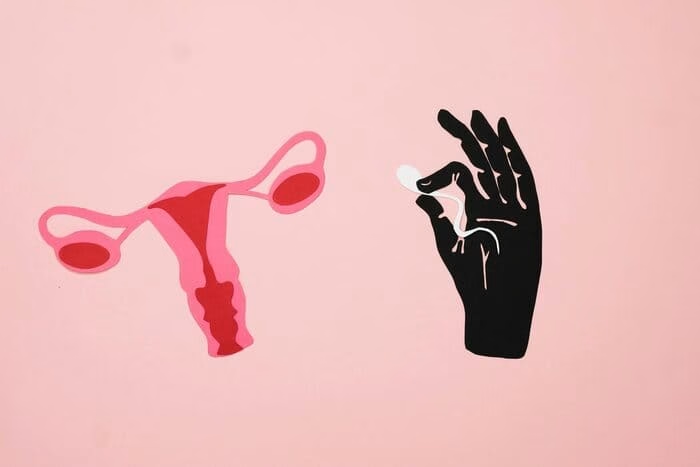
Endometriosis is a condition in which tissue similar to the uterine lining grows outside the uterus, causing inflammation, pain, and in some cases, fertility challenges.
Globally, it is estimated to affect 1 in 10 women of reproductive age.
In Mexico, this translates to millions of women who, in many cases, do not receive a timely diagnosis.
And that is one of the central challenges.
Delayed diagnosis: years without clear answers
One of the most important facts about endometriosis is how long it takes to diagnose.
On average, it can take 7 to 10 years from the onset of symptoms.
During that time, many women:
- Normalize their pain
- Adjust their routines to cope
- Receive incorrect diagnoses
- Delay seeking specialized care
This not only affects quality of life, it can also have implications for reproductive health.
The underlying issue: what gets normalized
Part of the delay in diagnosis stems from a deeply rooted belief:
that severe menstrual pain is “normal.”But it is not.
Some symptoms should not be overlooked, for example:
- Pain that interferes with daily activities
- Heavy or irregular bleeding
- Pain during intercourse
- Persistent fatigue
- Digestive issues linked to the menstrual cycle
- Difficulty conceiving
When these symptoms occur consistently, a thorough medical evaluation is recommended.
Endometriosis and infertility: an important connection
Endometriosis does not always lead to infertility, but it can be a contributing factor.
It is estimated that 30% to 50% of women with endometriosis may experience difficulty conceiving.
This may be related to:
Chronic inflammation
Changes in ovarian function
Alterations in pelvic anatomy
Interference with embryo implantation
What matters here is understanding that fertility is not an isolated concept—it is closely tied to overall health.
How is endometriosis diagnosed?
Diagnosing endometriosis is not always straightforward.
It typically involves:
- A detailed clinical evaluation
- Specialized ultrasound
- Magnetic resonance imaging (MRI)
- In some cases, laparoscopy
The complexity of diagnosis is one of the reasons many women go years without clear answers.
Available treatments: more options than before
Today, there are more options to manage endometriosis than in previous decades.
Treatment depends on each case, but may include:
- Pain management
- Hormonal therapy
- Surgery in specific cases
- Assisted reproduction for infertility
The goal is not only to control symptoms, but to improve quality of life and, when relevant, support fertility.
A less discussed side effect of endometriosis: emotional impact
Endometriosis is not only a physical condition.It also carries a significant emotional burden.
Living with chronic pain, diagnostic uncertainty, or difficulty conceiving can lead to:
- Stress
- Anxiety
- Frustration
- A sense of isolation
This dimension is often overlooked, yet it is an essential part of the experience.
Frequently asked questions about endometriosis
Does endometriosis have a cure?
There is no definitive cure, but treatments are available to manage symptoms and improve quality of life.
Does it always cause infertility?
No. Many women with endometriosis can conceive, although some may require medical support.
Is severe menstrual pain normal?
Not when it interferes with daily life or requires constant medication to function.
Can it be diagnosed with a simple test?
Not always. Diagnosis usually involves a combination of clinical evaluation and imaging.
On women’s rights: health, diagnosis, and informed reproductive choices
Talking about women’s health also means addressing something deeper: the ability to make informed decisions about one’s body and life. Within that context, fertility becomes central.
For years, conditions like endometriosis have not only been underdiagnosed, they have also quietly shaped reproductive decisions. Not necessarily by making pregnancy impossible, but by delaying diagnosis or limiting access to comprehensive care.
Advances in reproductive medicine, along with a better understanding of women’s health, have changed this perspective. Endometriosis is no longer viewed as an endpoint, but as a condition that can be treated, managed, and, in many cases, addressed while still preserving the possibility of pregnancy.
This is especially relevant at a time when more women are choosing when and how to pursue motherhood. Access to clear information and specialized care becomes essential in that process.
While biology sets certain parameters, there are now tools and medical approaches that allow for intervention, support, and, in many cases, the possibility of achieving healthy pregnancies, even in the presence of complex diagnoses.
Talking about endometriosis during Women’s Month is also about that: not limiting the conversation to symptoms, but expanding it to what is possible today.