
When people talk about the cost of In Vitro Fertilization (IVF), it is natural to think first about the fertility doctor or the egg retrieval procedure. But IVF is far more than a single medical act. It is a highly specialized treatment that combines diagnostic medicine, individualized clinical strategy, and extraordinarily precise laboratory work.
In reality, a significant portion of what you pay for IVF happens outside the body, in a controlled laboratory environment where each decision can directly influence the outcome.
Understanding IVF Costs Step by Step
Talking about IVF pricing also means understanding its complexity. IVF does not happen at one single moment, nor is it limited to one procedure. It is a medical and biological process that unfolds in phases, some inside the body and others entirely within the laboratory.
Not every clinic follows the exact same sequence, and not every step applies to every patient. Still, understanding this journey helps explain why IVF is considered a highly specialized form of medical care.
1. Ovarian Stimulation and Monitoring Costs
Treatment begins with a personalized hormonal protocol designed to stimulate the ovaries and encourage the development of multiple eggs within a single cycle. This phase is closely monitored through bloodwork and ultrasound. The goal is not to produce more eggs at any cost, but to obtain eggs with the best possible developmental potential.
2. Egg Retrieval Procedure and Surgical Fees
Once the follicles reach optimal development, the eggs are collected through a procedure known as follicular aspiration, or egg retrieval. This is performed in the operating room under sedation, making it painless and allowing the patient to return home the same day.
Immediately after retrieval, the eggs are transferred to the IVF laboratory, where the next phase of the process begins.
3. Sperm Collection, Analysis, and Selection in IVF
At the same time, a semen sample is collected and processed. During this stage, embryologists select sperm with the best characteristics to maximize the chances of successful fertilization.
4. IVF Fertilization Techniques and Laboratory Costs
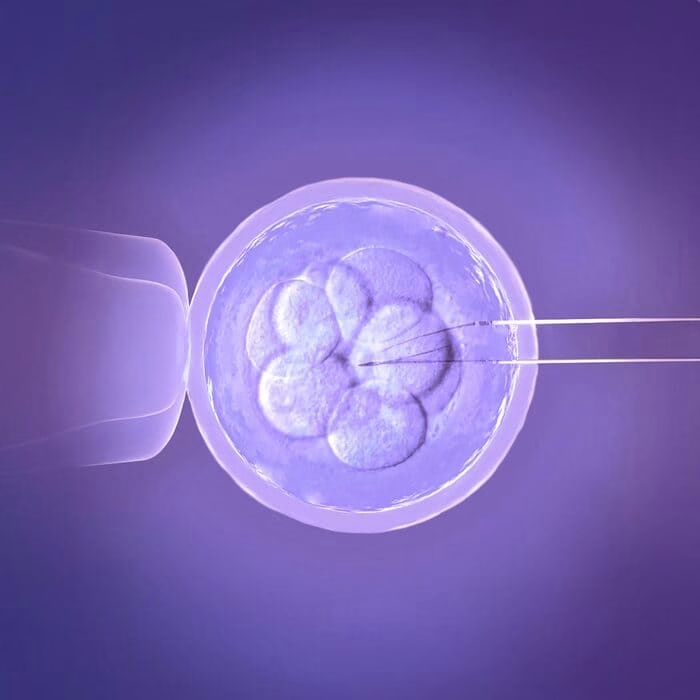
In conventional IVF, eggs and sperm are placed together to allow fertilization to occur naturally. However, at Nascere, fertilization is performed individually using high-precision techniques such as ICSI (Intracytoplasmic Sperm Injection) or PICSI. These methods allow embryologists to select sperm with better functional qualities before injecting a single sperm directly into each egg.
5. Embryo Culture Beyond Day 3: How Advanced IVF Laboratories Enable Blastocyst Development
Once fertilization occurs, embryos are cultured in the laboratory for several days. Traditionally, embryos were transferred on day 3 of development. Today, it is often possible to extend culture to day 5 or 6, when embryos reach the blastocyst stage.
This extended culture provides clearer insight into embryo development and viability before clinical decisions are made.
6. Endometrial Preparation and Uterine Synchronization
While embryos are developing, the endometrium, or uterine lining, is prepared to receive them. Synchronization between embryo development and the uterine environment is critical for implantation and is carefully personalized for each patient.
7. Embryo Transfer and Clinical Precision
Embryo transfer is the moment when the physician carefully guides the selected embryo into the uterus, ensuring the endometrium is optimally prepared. This step is meticulously planned and tailored to each patient, as timing and synchronization play a major role in implantation success.
8. Embryo Freezing and Cryopreservation (When Applicable)
In some cases, additional high-quality embryos may be frozen for future use. This step is not always possible and depends entirely on the individual response to treatment.
9. The Two-Week Wait and Pregnancy Test
The final phase is known as the two-week wait, the period between embryo transfer and the pregnancy test. It is often the most emotionally intense stage of IVF, as it is when implantation success is confirmed.
What Factors Influence the Cost of IVF?
IVF pricing is not determined by a single procedure or moment. It reflects multiple stages designed to support the reproductive process with greater information, precision, and control.
An IVF cycle includes medical evaluation, treatment planning, clinical monitoring, and the work of a specialized embryology laboratory. Costs are also influenced by fertilization techniques, the length of embryo culture, and, in some cases, the use of genetic testing to guide decisions before transfer.
For this reason, comparing IVF prices between fertility clinics is not simply a financial comparison. It is a comparison of medical philosophy, available technology, and how each clinic approaches patient care.

The Critical IVF Laboratory Window: What Happens Outside the Body
Once eggs are retrieved, one of the most delicate phases of IVF begins. This is a short but decisive window during which the eggs are no longer protected by the body and depend entirely on the laboratory, the technology, and the expertise of the embryology team.
During this time, eggs are fertilized and begin dividing into embryos. Traditionally, many clinics performed embryo transfer around day 3 of development. The challenge is that at this stage, embryos have not yet had enough time to express viability signals clearly. Even under a microscope, it is difficult to determine whether an embryo has true implantation potential or if development will stop later.
Extended culture to day 5 or 6, when embryos reach the blastocyst stage, offers much more meaningful information. By this point, embryos have undergone more cell divisions and have had time to reveal signs of strength or warning signs. Not all embryos reach this stage, which is precisely why extended culture functions as a natural selection process.
Even so, it is important to be clear. Reaching the blastocyst stage does not guarantee implantation. The only objective way to anticipate failed implantation is through preimplantation genetic testing (PGT), which evaluates whether an embryo has the correct chromosomal makeup before transfer.
This brief period outside the body is not just a technical step. It is where much of IVF success is defined, and where laboratory decisions, culture time, and access to advanced technology make a real difference in outcomes.
During these critical days, several outcomes are possible. Eggs may fail to fertilize, embryos may stop developing, or transfer may occur without implantation. When this happens, rather than asking what went wrong, it is worth asking whether the right information was available from the beginning to make better decisions.
What Are the Most Common Causes of Implantation Failure?
Implantation failure is often related to genetic abnormalities in the embryo, lack of synchronization with the endometrium, uterine or immunological factors, or incomplete diagnosis. For this reason, proceeding with IVF without a thorough evaluation should be considered a red flag.

Diagnosis as the Foundation of Fertility Treatment
IVF should never be approached as a trial to see if it works. It is a treatment justified by clear diagnosis and personalized strategy. Fertility evaluation helps determine whether infertility factors are female, male, or combined, and guides treatment with precision.
In experienced fertility clinics, an unexplained infertility diagnosis is becoming increasingly rare thanks to advanced hormonal testing, specialized sperm analysis, genetic studies, and detailed uterine evaluation.
Why Many Fertility Treatments Eventually Lead to IVF
In most cases, assisted reproductive treatments progress from lower to higher complexity. Ovulation induction is often tried first, followed by intrauterine insemination (IUI), and finally IVF. This is why IVF is often viewed as a last resort. It is also the most effective option due to its level of control, precision, and technology.
However, there are situations where IVF should be the first option from the start. One clear example is tubal factor infertility, when the fallopian tubes are blocked, damaged, or absent.
IVF vs. Tubal Reversal Surgery: Cost, Success Rates, and Outcomes
A common scenario involves women who underwent tubal ligation years ago and later decide they want another child. Many choose to attempt tubal reversal surgery instead of IVF, believing that since they conceived before, restoring the tubes will restore fertility.
The reality is more complex. Fallopian tubes are delicate structures, and any surgery can result in permanent damage, adhesions, or dysfunction that reduces or eliminates fertility. Tubal reversal does not guarantee pregnancy, and many patients ultimately require IVF anyway, after losing months or years in the process.
IVF bypasses tubal obstacles entirely. Whether tubes are blocked, damaged, or removed, fertilization occurs outside the body and the embryo is placed directly into the uterus. In these cases, IVF is not a last resort. It is the most direct and effective solution from the beginning.

The Role of the Laboratory in IVF Treatment and Success
Not all IVF laboratories operate under the same standards or with the same technology. A key example is embryo culture duration. Traditionally, embryos were cultured until day 3, but at that stage, development still provides limited insight into true viability, even under microscopic evaluation.
Today, more advanced approaches include extended culture to day 5 or 6, when embryos reach the blastocyst stage and have had time to demonstrate developmental potential. Still, the only objective way to anticipate implantation failure is through preimplantation genetic testing, which evaluates implantation potential before transfer.
Do Multiple IVF Cycles Improve Success Rates or Increase Costs?
Some clinics promote multiple IVF cycles as a solution or guarantee of success. However, repeating cycles without a clear strategy does not improve outcomes. It only increases emotional exhaustion, time investment, and frustration.
Preventing failed attempts begins with accurate diagnosis and truly personalized treatment planning.
Understanding IVF Costs Through a Medical Perspective: Orthodontics and Fertility
IVF costs become easier to understand when compared to other areas of medicine that have evolved over time. Orthodontics is a familiar example. Many people had braces as teenagers and later used clear aligners to refine results. This does not mean the initial treatment was wrong. It reflects how diagnostics, technology, and expectations changed.
Fertility treatment follows a similar path. IVF is a relatively young field that has advanced rapidly thanks to improved diagnostics and greater laboratory precision. When these advances are not considered from the outset, treatments often become prolonged or repeated without a clear plan.
Over time, this leads to greater emotional strain and cumulative costs that may equal or exceed the cost of a more comprehensive approach from the beginning.
Viewing IVF pricing through this lens shows that it is not about paying for an attempt. It is about choosing an approach aligned with current medical standards and individual needs.
Understanding IVF Costs Through a Medical Perspective: Orthodontics and Fertility
Reaching IVF often comes with fatigue, financial investment, and sometimes loss of trust in medical care. Assisted reproduction is a highly specialized field and is not always approached early from general medicine or gynecology.
Choosing a fertility clinic with deep diagnostic capabilities, extensive experience, and a high-level laboratory does not make IVF more expensive. It makes it more intentional, more strategic, and more likely to lead to meaningful results.