
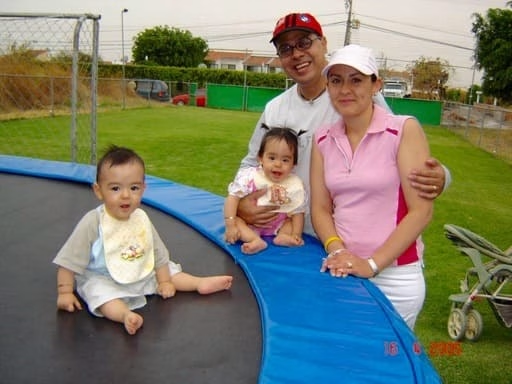
Before becoming Nascere’s first family, Graciela and Mauricio had already spent years building a life together and sharing a dream that mattered deeply to both of them: having children. They married in 1999 and, a couple of years later, began trying to get pregnant. As the months passed, they realized it was not happening the way they had expected, and a different kind of search began: trying to understand the reason.
It is an experience shared by millions of people. The World Health Organization estimates that approximately 1 in 6 people of reproductive age experience infertility at some point in their lives. And although for decades the search for an explanation focused primarily on women, today we know that this perspective is incomplete. The American Society for Reproductive Medicine notes that male factors are the primary cause in approximately 20% to 30% of infertility cases. Overall, nearly half of couples experiencing infertility have some male component involved. Even so, many evaluations still follow the same pattern: the woman is tested first, while the male factor is often left out.
Graciela and Mauricio’s journey followed that path as well. Time passed, and with it came appointments, tests, and medical evaluations. For Graciela, that period meant undergoing several different studies and eventually surgery. Then, in the middle of everything, something happened that seemed to change the course of their story: Graciela conceived naturally, but suffered a pregnancy loss at seven weeks.
She remembers that moment as an overwhelming combination of emotions. The loss came on top of a search that still had no clear answers, and grief had to coexist with the need to keep going. More tests followed, some of them particularly uncomfortable, along with medications and additional evaluations. Over time, the experience began to feel long and exhausting. It was not simply about going to doctor’s appointments. It was about doing all of that while living with the uncertainty of whether they would ever succeed.
Understanding Infertility Means Looking at the Bigger Picture
The WHO defines infertility as a disease of the male or female reproductive system characterized by the failure to achieve a pregnancy after 12 months or more of regular unprotected sexual intercourse. That definition provides a clinical benchmark, but it does not mean fertility can be understood by looking only at the reproductive organs.
The reality is much broader. Infertility is not a single disease with a single cause, and there is no single test capable of explaining every case. Understanding why pregnancy is not happening may require several different pieces of information and, very often, the answer lies in how those pieces interact.
Depending on the individual and their medical history, a fertility evaluation may need to consider factors such as:
- Ovulation and ovarian function.
- Hormonal balance and endocrine system function.
- The fallopian tubes and uterine anatomy.
- Sperm production, concentration, motility, and characteristics.
- Conditions such as PMOS, previously known as polycystic ovary syndrome, which can affect ovulation and also has hormonal and metabolic components.
- Previous illnesses, surgeries, infections, or medical treatments.
- Metabolic and overall health factors that may be related to reproductive function.
- Age, lifestyle, and certain environmental exposures.
- The interaction between male and female factors.
- Cases in which, even after multiple variables have been studied, no single cause can be identified.
That is why, at Nascere, we aim to approach fertility in an interdisciplinary and comprehensive way. It is not simply a matter of asking whether the ovaries are working, whether the fallopian tubes are open, or whether sperm are present. It means understanding the individual and the couple more fully, identifying which variables truly matter in their particular case, and connecting findings that, when viewed separately, may reveal only part of the picture.
When a couple is trying to conceive, that same breadth of evaluation should apply to both partners. There is no medical reason to assume from the beginning that the explanation must lie with the woman.

The Missing Piece Came From Mauricio’s Evaluation
For Graciela and Mauricio, changing that perspective would ultimately reveal the missing piece.
Mauricio recalls being diagnosed with a varicocele and a low sperm count. He also remembers undergoing surgery. After a period in which Graciela had gone through multiple tests and procedures, discovering a male factor that also required attention changed the way they understood what they were facing.
Looking back, Mauricio sums up much of what they learned in one very simple recommendation:
“If a couple is having trouble getting pregnant, make sure the future dad gets checked from the very beginning, too.”
The message captures what Mauricio expresses throughout his testimony. It is not about shifting responsibility from one person to another. His experience points in the opposite direction: working as a team and evaluating the couple together to identify the cause, rather than turning fertility into a search for someone to blame.
What Is a Varicocele?
Mauricio was diagnosed with a varicocele, an enlargement of the veins within the scrotum. It is a male reproductive health condition that, in some cases, can affect sperm production. Like any other factor related to fertility, its relevance is best understood alongside the patient’s medical history and other test results. It is one more medical variable that may be part of the evaluation when a couple is trying to conceive.
One of the tests used to better understand male fertility is a semen analysis. Among other parameters, it can evaluate:
- Sperm concentration
- Sperm motility
- Sperm morphology
Evaluating the male partner does not automatically mean searching for a male diagnosis. It means giving that part of the reproductive process the attention it deserves as well.
But for Graciela and Mauricio, one decisive encounter was still ahead.
A Television Interview That Changed Their Course
It happened at home while Mauricio was watching television. On a news channel, Dr. Gerardo Barroso was being interviewed about infertility and its possible causes.
Mauricio began looking into where Dr. Barroso practiced, researched his options, and scheduled an appointment. After so many consultations, meeting a new physician offered the possibility of a fresh start. Both Graciela and Mauricio especially remember the sense of trust they felt during those appointments. Mauricio describes an empathetic, committed, and enthusiastic physician. Graciela remembers how much time was dedicated to listening, understanding, and explaining. For a couple who had spent years accumulating questions, that meant a great deal.
Eventually, they both agreed: this was where they wanted to stay.
The Beginning of a New Chapter for Graciela and Mauricio: IVF
The treatment they decided to pursue was in vitro fertilization.
In vitro fertilization, or IVF, is one of the most advanced forms of assisted reproduction. Whether it is recommended always depends on the diagnosis, medical history, and individual needs of each person or couple. Although every treatment is tailored to the patient, the process is generally organized into several stages:
- Ovarian stimulation and monitoring.
- Egg retrieval.
- Collection and evaluation of the sperm sample.
- Fertilization in the laboratory.
- Embryo development.
- Transfer of an embryo into the uterus, when appropriate.
These stages may vary depending on the needs and characteristics of each case.
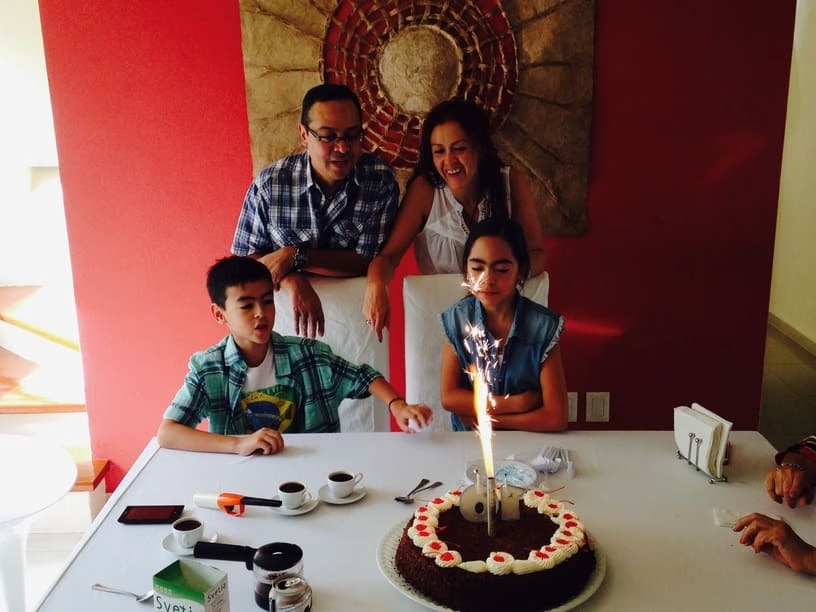
Graciela and Mauricio began treatment almost immediately. That same month, they achieved their pregnancy. They both admit they had imagined the process would take much longer. IVF was the first option they were trying with their new medical team, and they thought they might eventually need to move on to other alternatives. Instead, the news they had wanted for so long arrived.
Graciela remembers exactly how they found out:
“We came in for our appointment, and jokingly he told me, ‘I have good news and bad news. The good news is that you are pregnant, and the bad news is that there are two.’ But the truth is, we were very, very happy that there were two.”
They were expecting twins.
Nascere’s First Family
Over time, that experience took on another meaning. Graciela and Mauricio became Nascere’s first family.
For us as a clinic, that is more than a chronological fact. It represents the beginning of something that, many years later, remains at the heart of what we do.
Before there were many other families, there was one. Before we could look back and recognize a history of caring for patients, there were Graciela and Mauricio, going through their own appointments, questions, tests, and waiting. And then their children arrived.
Some parts of this story are better heard directly from them: how they remember those months, what it meant to go through them together, the difficult decisions they faced, the arrival of their children, and the way the experience ultimately brought them even closer as a family. Graciela and Mauricio tell their story with the perspective that comes with time, but also with an emotion that is difficult to fully capture in writing.
Click the video to hear their story in their own words.
For Nascere, Graciela and Mauricio will always hold a special place in our history as the first family to allow us to accompany them on their journey.